Welcome to The Real Blogger Status - Beta. Please note the warnings (as of 6/13: 0 active), and the alerts (as of 1/10/2007: 5 active).

Please be aware of the naming variances in this blog. You will find various references to "Classic" / "Old Template 2006" Blogger, and to "Beta" / "New Template 2006" Blogger.
Showing posts with label DNS. Show all posts

Sunday, February 11, 2007

Google Custom Domain - The DNS Server Definition

Of the confusion surrounding definition of Google Custom Domains in DNS, second only to the confusion about the DNS Referral definition, is the DNS Server definition.

(Note): This post has been migrated to (and improved in) The Real Blogger Status: The Google Custom Domain Setup - The DNS Server Definition.

Google does not provide the name servers needed for Google Custom Domains to work - the name servers must be provided by your registrar. The name servers are indicated by "NS" records, pointing to 2 - 8 servers owned by the registrar. You do not change the "NS" records.

The "NS" records point to the DNS servers provided by your DNS hosting company. You pay for the DNS hosting service, and the DNS hosting company sets up the "NS" records, on your behalf.

The name servers, provided by your registrar, are where the domain definition records, such as "A" (Address), "CNAME" (Canonical Name), and "MX" (Mail Exchange), among others, are stored. You have to provide a "CNAME" record on those servers, with that "CNAME" record pointing to "ghs.google.com", for your blog to be referenced as part of a Google Custom Domain.

>> Top

Friday, February 09, 2007

A Tale Of Two Domains

Blogger rolls on, and upgrades their product in silence. Here we see another example of that process.

We're going to examine two blogs - MartinezUMC and ToaCx4. We'll start with excerpts from the ever useful DNS Report, provided (free) by DNS Stuff.


martinezumc .org


The relevant portion of the DNS Report for the domain for my church blog, previously examined in my Case Study #2.


toacx4 .info


The relevant portion of the DNS Report for the domain for JaceMan's blog "toacx4".


Next, the ever available "ping" command, to test name resolution.

C:\>ping martinezumc.org

Pinging ghs.l.google.com [64.233.179.121] with 32 bytes of data:

Reply from 64.233.179.121: bytes=32 time=92ms TTL=244
Reply from 64.233.179.121: bytes=32 time=94ms TTL=244
Reply from 64.233.179.121: bytes=32 time=92ms TTL=244

Ping statistics for 64.233.179.121:
Packets: Sent = 4, Received = 4, Lost = 0 (0% loss),
Approximate round trip times in milli-seconds:
Minimum = 92ms, Maximum = 94ms, Average = 92ms

C:\>ping www.martinezumc.org

Pinging ghs.l.google.com [66.249.81.121] with 32 bytes of data:

Reply from 66.249.81.121: bytes=32 time=94ms TTL=244
Reply from 66.249.81.121: bytes=32 time=92ms TTL=244
Reply from 66.249.81.121: bytes=32 time=93ms TTL=244

Ping statistics for 66.249.81.121:
Packets: Sent = 4, Received = 4, Lost = 0 (0% loss),
Approximate round trip times in milli-seconds:
Minimum = 92ms, Maximum = 94ms, Average = 93ms

C:\>ping toacx4.info
Ping request could not find host toacx4.info. Please check the name and try again.

C:\>ping www.toacx4.info

Pinging ghs.l.google.com [66.249.81.121] with 32 bytes of data:

Reply from 66.249.81.121: bytes=32 time=93ms TTL=244
Reply from 66.249.81.121: bytes=32 time=92ms TTL=244
Reply from 66.249.81.121: bytes=32 time=106ms TTL=244
Reply from 66.249.81.121: bytes=32 time=93ms TTL=244

Ping statistics for 66.249.81.121:
Packets: Sent = 4, Received = 4, Lost = 0 (0% loss),
Approximate round trip times in milli-seconds:
Minimum = 92ms, Maximum = 106ms, Average = 96ms


Finally, we'll load all 4 aliases for each blog.

We see a major difference in functionality here. The first, "martinezumc.org", loads its custom website properly for the root only, but not for "www.martinezumc.org". The second, "toacx4.info", loads the website properly for both the root and "www.toacx4.info".


martinezumc .blogspot .com


http://martinezumc.blogspot.com/, which redirects to http://martinezumc.org/


www .martinezumc .blogspot .com


http://www.martinezumc.blogspot.com/


martinezumc .org


http://martinezumc.org/


www .martinezumc .org


http://www.martinezumc.org/ is a 404 at Blogger


toacx4 .blogspot .com


http://toacx4.blogspot.com/, which redirects to http://www.toacx4.info/


www .toacx4 .blogspot .com


http://www.toacx4.blogspot.com/


toacx4 .info


http://toacx4.info/, which redirects to http://www.toacx4.info/


www .toacx4 .info


http://www.toacx4.info/


So why did I refer to The Silence, here? Because less than a week ago, we were told that .info TLDs cannot be used with Custom Domains.

(Edit 2/9 21:00): In custom domain with 1 & 1 hosting, we see the same situation with Cool Looking Stuff as with Martinez UMC.

>> Top

Google Custom Domain - The DNS Referral

Of all of the instructions in the process of setting up a Google Custom Domain for your Blogger blog, none seems to generate so much confusion as setting up the DNS Referral. The instruction itself is so simple,

Add a "CNAME" record. Point "www.yourdomain.com" to "ghs.google.com". And leave the "NS" records to be maintained by your DNS provider.


(Note): This post has been migrated to The Real Blogger Status: The Google Custom Domain Setup - The DNS Referral.

But why a "CNAME" record? And why "ghs.google.com"?
  • The host "ghs.google.com" is a load balancing server array. When the reader's DNS client asks for the address of "ghs.google.com", it gets the address of whatever server is available right now.
  • In order for you to refer DNS traffic for "yourdomain.com" to "ghs.google.com", rather than to "64.233.179.121" (among many possibilities), you have to use a "CNAME" record. An Address ("A") record will only point to an IP address; to point to a host name you must use a Canonical Name ("CNAME") record.
When a reader of your blog points his browser in your direction, he is referred to "ghs.google.com".

The host "ghs.google.com" then provides a specific IP address, pointing to the single server that will be used to serve your blog to this reader. Another reader for your blog will be accessing it thru a different IP address, using another server. This is called "load balancing". If one readers accesses your blog thru server "D", another reader may access it thru server "F", and a third thru server "G". If server "B" is down, "ghs.google.com" won't offer it for referral. Other readers of other blogs may be using servers "A", "C", and "E" at the same time.

Google provides a load balancing server array, to give your readers the best possible experience. Use the array, not a single server, nor a URL referral. Or prepare for complaints
Gee, your blog performance sucks.


>> Top

Thursday, February 08, 2007

Custom Domains And URL Forwarding - A Bad Idea

If you're trying to get your Custom Domain setup to work, and are frustrated (as I am) by the fact that you can't get both "www.yourdomain.com" and "yourdomain.com" to forward properly, you may have complained to your DNS provider, suspecting that the problem is one which they must resolve.

And in some cases, your DNS provider may not know how to setup a "CNAME" record. Some providers only use "A" records.

Some DNS providers will convince you to use URL forwarding, where your domain is redirected to the DNS providers servers. They set their servers to simply load any portion of the desired website ("www.yourdomain.com" or "yourdomain.com") from your Blog*Spot website ("yourblog.blogspot.com").

This will indeed load the content, as desired. There are several downsides to this "solution", though.

  • Your DNS provider may have to set this up in their servers, it's possibly not a DNS setting that you can make.
  • As the reader views your redirected blog, the content of the address bar in the browser will constantly indicate "www.yourdomain.com" or "yourdomain.com", with no detail about the actual URL being viewed.
  • We're unsure about how well search engine spiders, and other robotic visitors, will react to URL forwarding.
  • URL forwarding bypasses the load balancing provided by "ghs.google.com", and this is bad for everybody.


Blogger has admitted that Custom Domains needs work. Let's wait for them to figure out how it should be setup, at their end. Try and avoid using URL Forwarding, unless you are really desperate.

>> Top

Wednesday, January 31, 2007

Google Custom Domain - Case Study #2

I've been working with Google Custom Domains for several weeks now, first on other peoples domains, then some on my own, and finally on more of other people. In very few cases can someone get a custom domain to work completely.

We'll take my church blog as an example here, as we did with Case Study #1. This blog has 4 aliases.

  1. http://martinezumc.blogspot.com/
  2. http://www.martinezumc.blogspot.com/
  3. http://martinezumc.org/
  4. http://www.martinezumc.org/


Current DNS settings


Simply one "CNAME" pointing to "ghs.google.com". No "A" record, as discussed in Google Custom Domain - The DNS Referral.

Let's test what we have now.
C:\>ping martinezumc.org

Pinging ghs.l.google.com [66.249.81.121] with 32 bytes of data:

Reply from 66.249.81.121: bytes=32 time=124ms TTL=244
Reply from 66.249.81.121: bytes=32 time=126ms TTL=244
Reply from 66.249.81.121: bytes=32 time=123ms TTL=244
Reply from 66.249.81.121: bytes=32 time=143ms TTL=244

Ping statistics for 66.249.81.121:
Packets: Sent = 4, Received = 4, Lost = 0 (0% loss),
Approximate round trip times in milli-seconds:
Minimum = 123ms, Maximum = 143ms, Average = 129ms

C:\>ping www.martinezumc.org

Pinging ghs.l.google.com [66.249.81.121] with 32 bytes of data:

Reply from 66.249.81.121: bytes=32 time=126ms TTL=244
Reply from 66.249.81.121: bytes=32 time=124ms TTL=244
Reply from 66.249.81.121: bytes=32 time=126ms TTL=244
Reply from 66.249.81.121: bytes=32 time=122ms TTL=244

Ping statistics for 66.249.81.121:
Packets: Sent = 4, Received = 4, Lost = 0 (0% loss),
Approximate round trip times in milli-seconds:
Minimum = 122ms, Maximum = 126ms, Average = 124ms


Both "martinezumc.org" and "www.martinezumc.org", verified by pinging, pointing to "ghs.google.com".


I can publish to martinezumc .org with no problem


I cannot publish to www. martinezumc .org.


And once again, the infamous
Another blog is already hosted at this address

And here, for reference, is a DNS Report for martinezumc.org.

(Edit 2/7): Blogger Employee promises us
We're working on a fix for the current problem some users experience when switching between custom domains and Blog*Spot.


(Edit 2/12): Blogger Employee understands the frustration.

>> Top

Monolithic Errors #2

Setting up a blog, published to a Google Custom Domain, is a two step process.

  1. You setup DNS pointing to the Custom Domain server "ghs.google.com".
  2. You publish your blog to the custom domain.
And some folks have been able to do just that.

But many others can't. And we all get one error, consistently.
Another blog is already hosted at this address.


What does this error mean? I suspect that Blogger is validating the DNS pointer, before setting up the relationship between the Blog*Spot blog (which is what we currently have) and the Custom Domain. And, if the DNS doesn't point to "ghs.google.com", then the custom domain must be in use somewhere else.

An alternate possibility is that there is a pointer somewhere in the Blog*Spot blog that points somewhere already. Or maybe the Blog*Spot blog can't be found.

Either way, Blogger needs to fix this problem. At least, add a few "bx-" codes, to let us know what the hell is going on, and so we can enumerate the problem in the forums.

>> Top

Saturday, January 27, 2007

The Trinity, and Your Web Site

The power and majesty of the trinity has been a part of mankind for years, before the Internet. From religion (the Christian nature of the supreme being - The Father, The Son, and The Holy Ghost), to properly robust systems, using triple redundancy (as in Robert Heinlein's science fiction - "I tell you three times that this is so"), the number three has always had almost mystical significance.

And with your web site, there is a trinity too. You are using, and may be paying (directly or indirectly) for 3 different services.

  1. Registration.
  2. DNS Hosting.
  3. Content Hosting.


If you have a domain purchased thru GoDaddy, and hosted on their services (maybe a blog published using FTP), you may have a package deal, with all 3 services on one yearly bill. Or you could purchase (register) your domain from any of dozens of registrars, have DNS provided by another company, and host your web site on a third, like Blogger. That's your choice, based upon your needs.

All Internet service companies don't provide all 3 services. GoDaddy does. Blogger / Google provides only content hosting, if you publish your blog to a Google Custom Domain.
You can register domain names from any of a number of different registrars, and you can use .com, .org, .net or any other valid addresses. Remember: you only need to get the domain name; you don't have to pay extra for hosting service.


Registration
When you purchase your domain, you want to know beforehand that nobody is already using it. And you want to ensure that, in the future, nobody uses it. You pay for the uniqueness of your domain name.

DNS Hosting
When you pay for DNS (directory listing), you want to know that your domain can always be located. Redundant DNS servers, geographically separated, is important for high visibility web sites. You pay for the address listing of your domain name.

Now this little detail may not be important to you.
Chuck, this doesn't matter to me. I pay my ISP for service, and they tell me to configure "ns1.myisp.com" and "ns2.myisp.com" (or their IP addresses) as my DNS servers. Why do I care about whatever DNS server Google uses?


Well, I'll ask you to think about this. You use your ISPs DNS servers so you can access websites. You pay for DNS hosting so your readers can access your website. Both your ISPs DNS servers, and your readers ISPs DNS servers, have to ask your DNS host for the address of your website.

You write your blog for your readers. Your readers DNS servers have to find out the address of your web site. How many repeat readers do you expect to have, if they try to access your web site and see
404 Server Not Available
or a similar error?

Content Hosting
When you pay for Content Hosting, you want to know that your web site itself will always be online. Whereas a DNS retrieval is a small (but significant) amount of traffic, and of server space, your blog (web site), as it grows, will use increasingly larger amounts of server space, and generate increasingly larger amounts of traffic. Your content host needs a large and reliable connection to the Internet, as well as reliable server hardware. You pay for the hosting of the web site itself.

If you have a blog hosted on Blog*Spot, you pay nothing at all. If you have a blog hosted on a Google Custom Domain, you pay nothing for the Content Hosting, just for registration and DNS.

The latter 2 services are generally billed yearly, and at a fixed rate. Content Hosting is generally billed by the month, and will be tiered based upon the amount of storage required (size of blog), amount of bandwidth generated (number of readers * size), and various server services required.

>> Top

Monday, January 15, 2007

Google Custom Domain - Case Study #1

OK, Chuck. Time to put your money where your mouth is.


I've been writing about Google Custom Domains for almost a week now.

So, it's time to test what I've learned.

(Note): This post has been migrated to The Real Blogger Status: Google Custom Domain - Case Study #1, and has been substantially expanded in The Real Blogger Status: Diagnosing Problems With Custom Domains, and in the series The Real Blogger Status: Custom Domains Diagnoses.

This case study uses my church website, martinezumc.org, with DNS service provided by GoDaddy. So, I logged in to the GoDaddy control panel, and followed the Google GoDaddy instructions (instructions for other hosting services are also in that document). Steps 1 - 4 were on target. So, I document below Steps 5 - 7 of the instructions, which became my steps 1 - 8.

Note that GoDaddy is simply the example that I use here. Blogger provides How do I create a CNAME record for my custom domain?, which provides instructions for half a dozen different popular DNS Hosting companies.

Step 1

The Default GoDaddy Settings


Here we see all DNS entries created by GoDaddy, when "martinezumc.org" was setup originally. All entries point to GoDaddy, using an "A" record equating "@" (the domain root) to "68.178.232.100".

Step 2

Just 2 Quick Changes


  1. I deleted the "A" record pointing the domain to GoDaddy.(See Note 2, below)
  2. I added a "CNAME" record equating "www" to "ghs.google.com".
For more detail about DNS records, see PCMagazine Definition of: DNS records, or FAQs.Org: How DNS Works.
(Note 1): This example is for a domain setup for the ".org" TLD, and using GoDaddy as the registrar. All experience so far indicates that the different TLDs (.com, .info, .net, .org, ...), and the different registrars (like GoDaddy) have different rules. Be careful here, and ask questions in Blogger Help Group: How Do I?, if anything here is not completely clear to you. We are still learning the details, and I suspect Blogger staff is too. If you have any doubt about the effectiveness of your DNS setup, execute Step7 below, and proceed only when you get similar results.
(Note 2): If you have an existing website with other content, and just want to add the blog as "blog.mydomain.com", don't delete the "A" record. Just add a "CNAME" record equating "blog" to "ghs.google.com".

Step 3
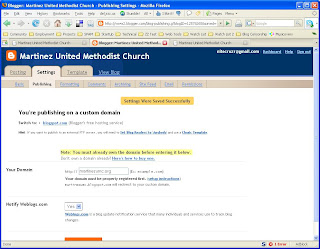
I Setup Blog Publishing


I went into Settings - Publishing for the blog currently published at "martinezumc.blogspot.com", selected "Switch to: Custom Domain", and set it to publish to "martinezumc.org". Note that it clearly warns us
martinezumc.blogspot.com will redirect to your custom domain.
with no mention of www.martinezumc.blogspot.com. This makes it unlikely that we should expect "www.martinezumc.org" to work.

Step 4

I Tested martinezumc .org


Success!

Step 5

I Tested www .martinezumc .org


Here we see just what I predicted, in Step 3, above.

Step 7
And to verify the GoDaddy setup (and diagnose the 404), a simple set of ping tests.
C:\>ping martinezumc.org

Pinging ghs.l.google.com [64.233.179.121] with 32 bytes of data:

Reply from 64.233.179.121: bytes=32 time=94ms TTL=242
Reply from 64.233.179.121: bytes=32 time=92ms TTL=242
Reply from 64.233.179.121: bytes=32 time=94ms TTL=242

Ping statistics for 64.233.179.121:
Packets: Sent = 4, Received = 4, Lost = 0 (0% loss),
Approximate round trip times in milli-seconds:
Minimum = 92ms, Maximum = 94ms, Average = 93ms

C:\>ping www.martinezumc.org

Pinging ghs.l.google.com [66.249.81.121] with 32 bytes of data:

Reply from 66.249.81.121: bytes=32 time=94ms TTL=242
Reply from 66.249.81.121: bytes=32 time=93ms TTL=242
Reply from 66.249.81.121: bytes=32 time=96ms TTL=242

Ping statistics for 66.249.81.121:
Packets: Sent = 4, Received = 4, Lost = 0 (0% loss),
Approximate round trip times in milli-seconds:
Minimum = 93ms, Maximum = 96ms, Average = 94ms


And there is a demonstration of the dynamic name resolution of "ghs.google.com".
64.233.179.121
hs-in-f121.google.com
66.249.81.121
bx-in-f121.google.com


And, seeing as "www.martinezumc.org" resolves properly, in this example to "66.249.81.121", we can conclude that the 404 above is coming from Google, not GoDaddy.

The host named "ghs.google.com" is a load balanced server array. It's provided to give your readers the best performance possible, when visiting your blog.


And, last but by no means least, the DNS Report for "martinezumc.org".

Please follow me now to the next post in this series.

>> Top
